Caught in the Middle East, Chinese Tourists Scramble for Way Out
For Lin Jun and his wife, a five-day holiday in Dubai ended with a hurried escape across the border into Oman.
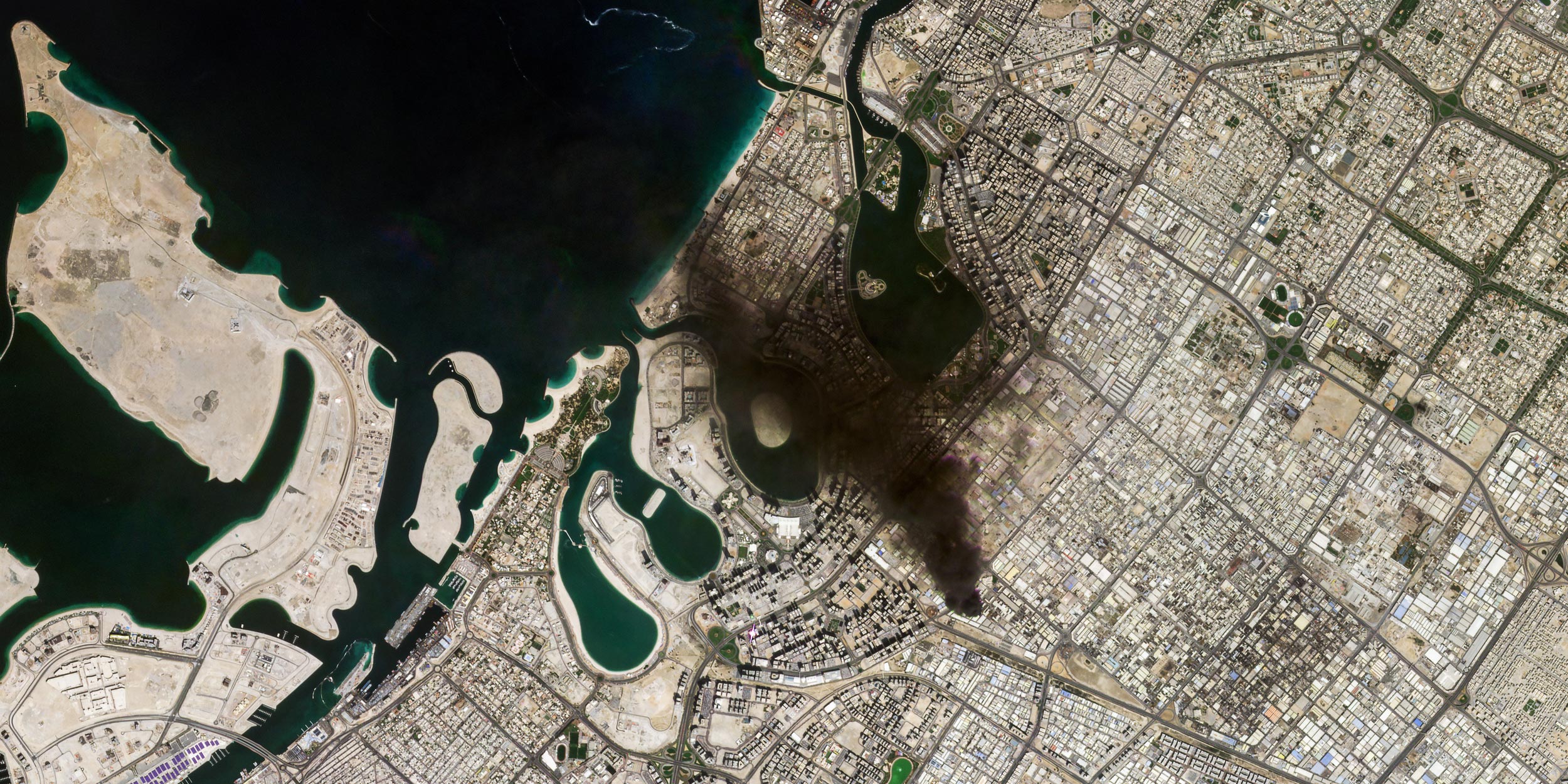
The couple’s trip unraveled as tensions across the Middle East rapidly escalated. Since Feb. 28, the U.S. and Israel have struck targets in Iran, while Tehran has responded with missile and drone attacks on U.S. military bases across the region.
For tourists caught in the uncertainty, the escalating conflict has quickly turned routine travel plans into a scramble for safety.
Lin and his wife landed in Dubai on the afternoon of Feb. 27, planning to spend five days exploring the city before flying on to Turkey. Yet within hours, several countries in the region, including Israel, Qatar, and Syria, had closed their airspace, while the UAE announced a “partial closure.” Dubai’s airports resumed limited operations on March 2, and the first flight to the Chinese mainland resumed on March 4.
For Lin, the holiday was over. Strolling along the beach near the Burj Al Arab hotel, he saw fiery streaks cross the sky — fragments from intercepted missiles. Seconds later came distant explosions.
Around midnight, Lin was jolted awake by a piercing alert on his phone. That night, he received two “terrifying” warnings from the UAE Ministry of Interior urging residents to “seek immediate shelter” due to potential missile threats.
The next morning, although afraid, the couple ventured outside and, to their surprise, found daily life in Dubai seemed normal. Shopping malls were open, and supermarkets were well stocked.
“The Middle East has had its share of conflicts. The locals are used to living with uncertainty. But we’re not used to living in a state of war,” Lin says, adding that the uncertainty made it impossible for him to do anything but constantly refresh the news on his phone.
Import-export trader Li Xin, who was visiting Dubai with her father, received the same text alert, but quickly silenced it. “I didn’t want to worry my father,” she says. Yet, she couldn’t prevent him from seeing the videos flooding social media about the situation. Unexpectedly, he remained calm, joking that, “If we can’t go back, I’ll just find a job here.”
About 15 kilometers away at Dubai’s port, Wang Yan was aboard the docked cruise ship MSC Euribia. The time on her phone flickered between time zones as the signal dropped in and out, leaving her worried the communications network had been disrupted.
Wang and her husband arrived in the UAE from Shanghai on Feb. 27 and boarded the cruise ship the next morning, joining more than 5,000 other passengers for a planned week-long voyage. However, the vessel never left the port, which lies close to a U.S. military base. Sitting in her cabin, Wang could hear fighter jets roaring overhead.
Seeking safe haven
Lin soon began looking for a way out. The best option, he felt, was Oman: the country offers visa-free entry for Chinese tourists, and Muscat International Airport still had flights to destinations in India and Southeast Asia.
With the help of a friend, Lin and his wife hired a private driver for 5,000 dirham ($1,360) to take them across the border on March 2.
“Packing felt like fleeing a disaster,” Lin recalls. “We left things behind. We still had a night left at the hotel but didn’t even check out, just in case we couldn’t get out of the country and had to come back.”
During the drive to Oman, Lin booked a flight from Muscat to Jakarta, capital of Indonesia, departing three days later. His one-way economy ticket cost more than 6,000 yuan ($870). Just hours later he noticed that the price had surged to 17,000 yuan.
After a 470-kilometer journey lasting five hours, the couple reached Muscat.
That same day around noon, Wang received a notice from the cruise company that the entire itinerary had been scrapped and the ship would remain docked in Dubai. She also learned that many passengers from the previous voyage had become stranded in the city after their return flights were canceled.
Passengers were allowed to disembark, but Wang didn’t dare venture far from the port. The terminal usually handles up to 14,000 visitors a day during the peak cruise season, but now it was nearly empty. Only two of the seven cruise ship berths were occupied, and the duty staff had been reduced to a skeleton crew.
Cruise employees recorded the nationality of passengers on board, and soon Wang received a message from the Chinese consulate offering assistance with repatriation. Amid the uncertainty, this was one thing she felt she could rely on. As of March 6, the couple was still in Dubai.
Black swan
For foreign-trade shipping professional Zhao Li, the effects of the conflict are already spreading beyond the Middle East.
Dubai’s Jebel Ali Port, the region’s largest, as well as ports in Kuwait, Saudi Arabia, and Qatar have been affected, disrupting shipping networks, while airspace restrictions have hit crew rotations for ships.
Since March 1, several tankers have reportedly been attacked in the Persian Gulf and the Strait of Hormuz, which many shipping companies are temporarily treating as “no-go zones.”
Zhao, who is based in Shanghai, says the normal rhythm of international trade virtually collapsed overnight.
“A global supply chain looks strong, but in the face of a black swan event, it’s incredibly fragile,” she says. “Except for a few shipowners willing to take risks and accept orders, almost all major shipping giants have come to a halt.”
The impact of the Middle East situation is rapidly widening, she adds. “Little by little, it’s drawing in people who once had nothing to do with the region.”
(Due to privacy concerns, all names in this article are pseudonyms.)
Reported by Zheng Ziyu, Zhang Lingyun, Chen Wei, and Xu Langyi.
A version of this article originally appeared in Original (Jiefang Daily). It has been translated and edited for brevity and clarity, and is republished here with permission.
Editors: Wang Juyi and Hao Qibao.
(Header image: A satellite image showing an explosion in Dubai, United Arab Emirates, March 1, 2026. Planet Labs PBC via AP/VCG)